

Books and Articles on Contemplative Psychotherapy
I am a published author and editor whose work explores the intersection of contemplative psychology, contemplative practice, and clinical psychotherapy. I co-edited Advances in Contemplative Psychotherapy (Routledge, 2023) — the most comprehensive introduction to integrating contemplative practices into mental health treatment — and have contributed chapters and articles to publications including Oxford University Press and A Moving Journal. My writing reflects the same approach I bring to my psychotherapy practice and my teaching: grounding the wisdom of contemplative traditions in practical, embodied, clinically useful knowledge.

Advances in Contemplative Psychotherapy: Accelerating Healing and Transformation (Routledge, 2023)
Co-Editor — with Joe Loizzo, Miles Neale, and Emily Wolf
Advances in Contemplative Psychotherapy offers mental health professionals of all disciplines and orientations the most comprehensive and complete introduction to the art of integrating contemplative psychology, ethics, and practices including mindfulness, compassion, and embodiment techniques. It brings together clinicians, scholars, activists and thought leaders of unprecedented caliber, featuring some of the most eminent pioneers in the rapidly growing field of contemplative psychotherapy and psychosocial change. The book’s contributor list reads like a who’s who of leading voices in contemplative psychology, pioneers in contemplative approaches to social justice, eminent scholars, neuropsychologists and master teachers of Buddhist practice including: Robert Thurman, Lama Rod Owens, Daniel Siegel, Tara Brach, Kamilah Majied, Paul Fulton, Sharon Salzberg, Jan Willis, Rick Hanson, Christopher Germer, Dr. Nida Chenagstang and Pilar Jennings.
This work directly informs my approach to psychotherapy and my teaching in the CBRT program at the Nalanda Institute.
Learn more.

Compassion-Based Resilience Training Student Manual
Co-Editor
The student manual is the main teaching tool for the CBRT program offered by the Nalanda Institute for Contemplative Science. It is used in both the 8-week CBRT groups as well as the 8-month CBRT Teacher Training. I worked as the managing editor for the revised edition.
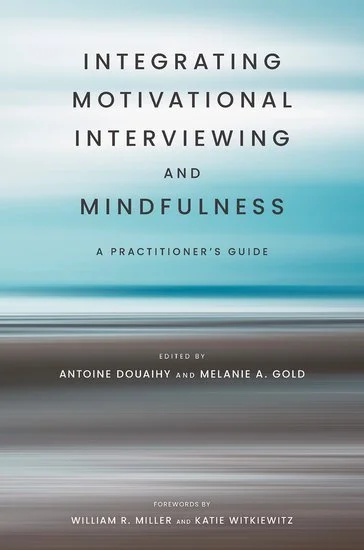
Mindfulness: Self-Healing Mechanism and Psychotherapeutic Ally (Oxford University Press, 2025)
Chapter in Integrating Motivational Interviewing and Mindfulness: A Practitioner Guide, edited by A. Douaihy & M. A. Gold
Here is an excerpt from my chapter: “Mindfulness is described as being nonjudgmental. Often this is interpreted as sweeping indiscriminate acceptance, but this is not accurate. Being nonjudgmental in a mindfulness context acknowledges the difference between something that is harmful and something that is helpful. In this way mindfulness uses discernment as an element in its self-healing process. During mindfulness meditation we actively use discernment to prune unhelpful cognitive, emotional, and visceral ways of being. Sharon Salzberg (2023), meditation pioneer explains, “We are constantly practicing discernment as part of the philosophy and psychology of mindfulness” (p.49). If we engage in mindfulness without discernment, then we will have no way to shear away unhelpful modes of being and cultivate positive ones. This ability to tend to our mind in a positive way is a critical part of the dynamism of mindfulness.”
Learn more and purchase the book here.
To get a taste of how I approach the direct experience of mindfulness using my guided meditation offerings.
Motivational Interviewing and Mindfulness: Divergence, Commonalities, and Practical Strategies for Integration. (Oxford University Press, 2025) By Antoine Douaihy (ed.), Melanie A. Gold (ed.), Cassandra L. Boness, Fiona Brandon, Livianna K. Myklebust
Chapter in Integrating Motivational Interviewing and Mindfulness: A Practitioner Guide, edited by A. Douaihy & M. A. Gold
This chapter focuses on the integration of mindfulness and motivational interviewing in clinical encounters. It highlights and reviews mechanisms of action, areas of divergence, convergence, challenges, and core strategies and opportunities for integration. It also reviews the benefits of integration of motivational interviewing and mindfulness. Both of these approaches focus on acknowledging core human values, empowering patients to change, and providing a catalyst for fostering motivation for change and behavioral action leading to positive outcomes. The chapter offers practical applications and tips for practitioners when combining the two modalities.
Learn more and purchase the book here.
To get a taste of how I approach the direct experience of mindfulness using my guided meditation offerings.

Compassion-Based Resilience Training (CBRT): A Contemplative Therapeutic Intervention for Self-Regulation and Cultivating Loving Intimate Relationships (Routledge, 2023)
Chapter Advances in Contemplative Psychotherapy: Accelerating Healing and Transformation (2nd ed.), edited by J. Loizzo, F. Brandon, M. Neale, & E. Wolf
Here is an excerpt from my chapter: “The majority of individuals and couples that I work with are unaware of the stress and dysregulation that their negative sense of self creates in regards to their perception of themselves and how in turn this affects their intimate relationships. They are innocent to the ways in which we bring a frightened, shame-based, and chronically stressed part of ourselves into our relationships. And they are unaware how, more often than not, we unconsciously react from this part of ourself in response to an exchange or experience with our intimate partner. Unless more mature ways of relating are modeled to us over the course of our emotional development, and more developed defenses are consolidated to navigate relational difficulties, our negative sense of self—like a child—will continue to consciously or unconsciously seek security, love, and emotional regulation from external sources. There is little understanding that love and security can also be sourced and regulated internally.”
The material in this chapter is central to my work with clients navigating codependency and intimacy challenges.

Magically Human
Magically Human. In A Moving Journal, Vol. 13.1, Spring 2006
Here is an excerpt from my article: “The key to the transformative healing process is - play is fun. In a seemingly magical way, the life-enhancing emotions (joy and interest) modulate and transform the emotions of crisis.” (Chodorow, p.6) During Authentic Movement, I do not try to control anything; I let myself play. The images that then arise help to soothe… confusion and frustrations…I also do not try to pin down the image by using psychological language, as I do not want to “reduce the imaginal to the conceptual, and in doing so keep out of relation to what we do not yet fully know.” (Watkins, p.137) I relish being in a place where I can do no wrong. My psyche drinks deeply of this energetic way of being because it balances my psyche’s more discerning yang qualities.”
My published work reflects the same integrative approach I bring to my psychotherapy practice, my clinical consultation with therapists, and my trainings and classes. If you are interested in working with me, I can be reached at 415.721.3355 or by email. I see clients via telehealth throughout California and in my San Francisco office in Noe Valley at 4155 24th Street, San Francisco, CA 94114.